I know this blog claims to focus on literary representations of the Arctic, but I need to share one more science-inspired article. This report (“Reindeer See a Weird and Wonderful World of Ultraviolet Light,” published on Science Daily May 29th, 2011) details fascinating new information about how reindeer see their environment: because they can see ultraviolet light, they can spot lichen, predators’ urine markings, and even the fur of such well camouflaged animals as wolves. For those of us who can’t see ultraviolet (so-called because the wavelengths exceed the visible [to human] color spectrum), lichen, urine, and wolves easily blend into the muted color scheme of the tundra (in summer) making us easy prey targets while in the winter we are susceptible to snow-blindness while reindeer are not.
The author sums it up pretty well:
Reindeer can not only see ultraviolet light but they can also make sense of the image to find food and stay safe. Humans and almost all other mammals could never do this as our lenses just don’t let UV through into the eye.
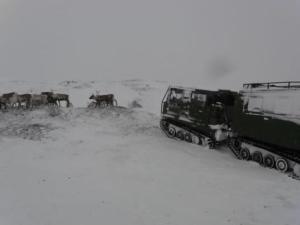
And this is what the world looks like in UV (photo credit Glen Jeffery):
Cracked.com recently published an entry on “7 Animals that Are Evolving Right Before Our Eyes,” with number one being of interest to those with an eye on the Arctic: the “Grolar Bear.” While a fairly typical Cracked post with emphasis on the extreme, the bizarre, or the ironic, the discussion about the grolar bear brought up at least one interesting point: polar bears are not just passively dying out, but finding novel ways to continue as a species. Or as, the author writes: “The horrifying thing about grolar bears is how they have carnivorous polar bear behaviors in bodies that are adaptable for warmer climates.”
And they’re moving south…
______________________________________________
ASLE Off-Year Symposium
June 14-17, 2012
University of Alaska Southeast
______________________________________________
We invite paper and panel proposals for the Association for the Study of
Literature and Environment’s Off-Year Symposium, “Environment, Culture, and
Place in a Rapidly Changing North,” to be held June 14-17 at the University of
Alaska Southeast in Juneau. Proposals related to the field of literature and
environment broadly, or to the symposium theme specifically, should include a
250-word abstract, paper title, your name, and affiliation. Proposals for
pre-organized panels are also welcome. Submit proposals to Sarah Jaquette Ray
(sjray@uas.alaska.edu) and Kevin Maier (kevin.maier@uas.alaska.edu) by November 5, 2011.
Theme:
The North American “North” of Alaska and Canada is an excellent geographical
imaginary through which to understand the human-nature concerns of our time.
Ecosystems transgress national boundaries, for instance, and Northern
communities experience the symptoms of climate change disproportionately
relative to their contribution to its acceleration. A symposium focusing on
“the North” suggests a transnational perspective of this paradox, as well as a
range of concerns, from peak oil and climate change to traditional ecological
knowledges and tourism. While the North is often seen as an isolated place
with a unique character, safe from the economic and environmental woes of “down
south,” this imaginary belies the North’s place within transnational phenomena,
such as colonialism, global climate change, and globalization.
The symposium’s keynote speaker will be Julie Cruikshank, Professor Emerita of
Anthropology at University of British Columbia, and author of Do Glaciers
Listen? Local Knowledge, Colonial Encounters and Social Imagination. One
secured plenary speaker, Ellen Frankenstein, will screen her documentary film,
Eating Alaska.
Topics:
We welcome proposals for papers, interdisciplinary research, or creative work on
issues related to literature and the environment, and also work that explores
the North American North, addressing (but not limited to) the following themes:
the North in the environmental imagination; global indigenous environmental
movements; subsistence/food security/food justice/food cultures;
traditional/local ecological knowledges; climate change; transnational North;
animals/animality/wildlife; boundaries/borders in the North; migrations.
The Civilians, “an investigative theater company based in Brooklyn, New York,” is developing a play addressing climate change. With support from the National Science Foundation, the play is set to debut in the 2011-2012 theater season. The play features “songs and video that focus on climate change and conservation.” You can read more about it here.
“The Great Immensity” is set in the town of Churchill, Manitoba and Colorado Island, Panama and “uses a combination of video images, arctic ice cap models and music to explore climate change on stage.”

****Update: The Predators hold their own and the teams head into the 6th game, to be played in Nashville. It’s 2:3 Canucks–it’s the first time that Nashville has made it this far in the playoffs and the Canucks have rarely made it much further. It’s going to be a nail biter!
I’d love to hear some thoughts on hockey as a northern sport. Anyone know the game’s history? The NHL seems to be a true binational league with teams and players spanning both the US and Canada (plus all the players from Scandinavia and Russia).****
Tonight could be the last game in the playoffs for the Stanley Cup between the Vancouver Canucks and the Nashville Predators. Not being one to particularly follow sports, I wouldn’t normally know this, but thanks to a couple of Canadian friends I’ve been able to track the progress of “my” team, the Predators. But wait, if I don’t follow sports in general and hockey in particular, how come I have a team? I don’t have a team so much as I have a player and that player is Jordin Tootoo. Tootoo is the first Inuk to play NHL hockey and I had the good fortune to meet him last summer before I traveled to Nunavut when I stayed at his cousin’s house. Not knowing a thing about hockey, I was quite oblivious to the connection until I walked out of my room one morning and was accosted with a bear hug from a very large man on my way to take a shower. This was my introduction to Jordin Tootoo. After recovering from the shock of our initial encounter and then setting some personal space boundaries, I was quite won over by Jordin’s irrepressible enthusiasm as an entertainer. Quickly figuring out that his cousin’s guests were of a slightly different caliber than (perhaps) his usual milieu, Jordin acted the consummate gentleman (when he wasn’t dangling his cousin’s children by the ankles) and storyteller. He told us about his recent trip back to Rankin Inlet, showed us pictures of the area, and talked about his childhood playing hockey in the north of Canada.
Jordin hasn’t had an easy time with fame, fortune, or family, but you can find the details to those tales in other places. This is just my little story of how I came to take an interest in hockey and I wish Tootoo and the Predators whatever extra edge they need against the Canuck’s tonight. I never thought I would say this, but GO NASHVILLE!
Read more about Jordin and the great second half of the season he is having here.

FAIRBANKS — A new website, Frontier Scientists, aims to link Alaska scientists with people curious about Arctic discoveries.
The site, located at http://frontierscientists.com, offers first-person accounts from scientists studying the North. The research, which comes in a variety of formats, is divided into six categories: grizzlies, petroglyphs, paleo-Eskimo, Cook Inlet volcanoes, Alutiiq weavers and climate change.
Greg Newby, the chief scientist of the UAF Arctic Region Supercomputing Center, is leading the project. The project is funded by the National Science Foundation, with support from the National Park Service and 360 North.
Read more: Fairbanks Daily News-Miner – Arctic website planned to link scientists with those curious
***It seems to me that the website is either including a few too many topics or leaving a few topics of concern out. What do you think? Have any suggestions for information you would like to see on such a website?***
If you have ever been confused about the seemingly random capitalization of “Arctic,” I have some good news for you.
The Arctic Institute of North America writes in their style manual for their journal, Arctic:
Capitalization: “Arctic” is capitalized when it is used as a noun (“the Arctic”). Used as an adjective, “arctic” is capitalized when it refers to the geographic region (i.e., Arctic communities) and lowercased when it refers to very low temperatures (i.e., arctic gale). Established names of Arctic flora and fauna are lowercased (i.e., arctic fox). The same rules apply for “subarctic.” “North” is capitalized only when referring to a specific geographical area or as part of a geographical name, never when used as a direction. “Antarctic” is always capitalized, as it refers to one of the great divisions of the earth’s surface and also to a particular continent, from which the adjective is derived.
The Institute and their journal are both well worth checking out. They are run out of the University of Calgary and seem to be quite interdisciplinary:
The institute’s mandate is to advance the study of the North American and circumpolar Arctic through the natural and social sciences, the arts and humanities and to acquire, preserve and disseminate information on physical, environmental and social conditions in the North.
You can access the journal articles from the website. Many are natural science and wildlife biology oriented with studies on bowhead whales, arctic terns, and the depletion of fish stock. But from my quick perusal, I also found brief examinations of travelogues, missionary statements and even a brief note on Lady Jane Franklin.
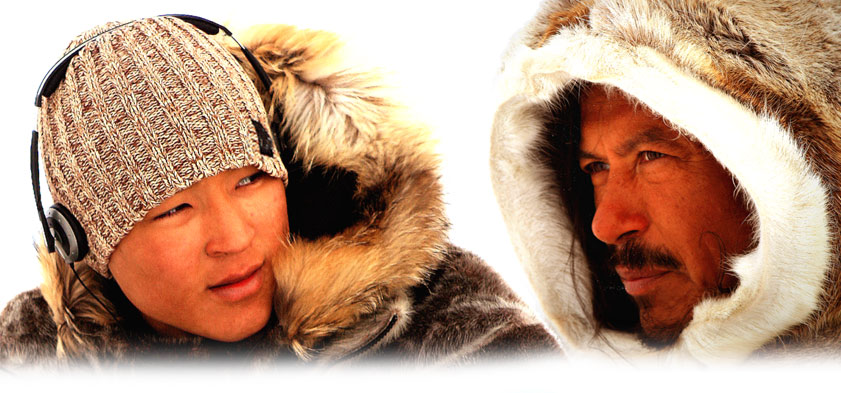
Inuk is an exciting new film about modern Inuit in Greenland and the journey of one young man to reconcile the seemingly disparate worlds in which he lives. I have only watched the trailer, but I can’t wait to find it on DVD!
The website is here or paste this link:
Or go directly to the film trailer:
http://www.inuk-lefilm.com/Trailer%20LQ.html
The opening sequence of the trailer features a modern sneaker stepping on a crack in hard packed snow. This evocative image seems to encapsulate the theme of the film: two worlds in contact through the figure of a young man learning to be an adult. Of course, the film also makes the two worlds idea more complex as any thoughtful piece would. To me, this first image is quite powerful and disturbing: sneakers are not warm shoes nor do they hold good traction on the ice. The fabric is flimsy and the rubber freezes. They are urban, city shoes. The crack in the hard packed snow is reminiscent of a fissure in ice; the impractical shoe and the fissure give me a sense of unease. Is the shoe bridging the gap or is it, and the person wearing it, about to fall through? Ultimately, from what I can tell from the brief scenes and action sequences, the film is about doing both and it is not particularly interested in saying that modern Greenlandic Inuit are more especially prone to “falling through the cracks” or more adept at “living between two worlds.” Rather, I imagine we are to think of the specificity of the story and how it marks time and place while also finding the connections to films and stories we already intimately know. The “universal” that allows audiences around the world to connect with the story. Such of course, was the project of Atanarjuat, the Fast Runner. This is not a reductive categorizing move to compare the two–I think it is a pretty fair statement to say that a film like Inuk could be made only after the success of previous films like the Fast Runner that are solely in Inuktitut. It’s how industry works, in literature and film. But I’m delighted about the success of one and the future success of the other and what that says about changing markets and perceptions about northern indigenous films!
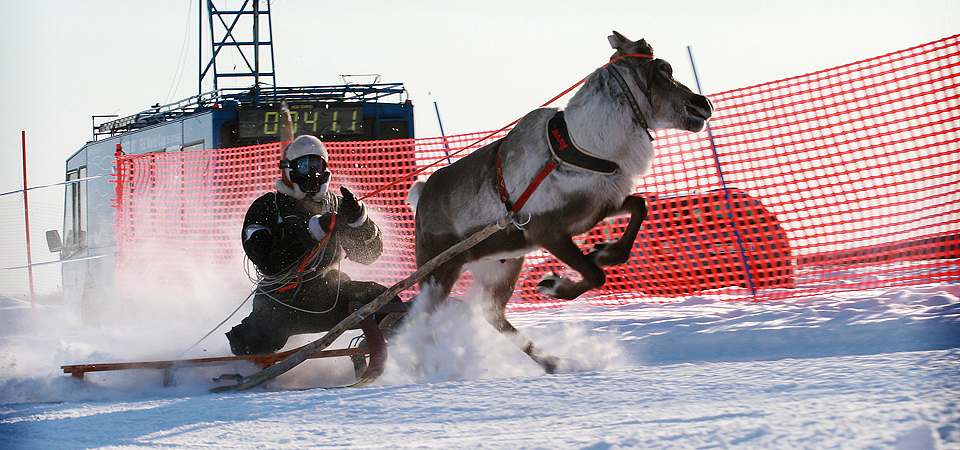
If you happen to be in Northern Europe around the 20th of April, I recommend heading to the Finnmark region of Norway, to a town called Kautokeino. Kautokeino, which means “open land that bristles with sedge from the forest” in Sami (according to a Norwegian tourism website) is a more or less permanent Sami community of 3000 people (more so in the winter, less so in the summer) that boasts a Sami cultural center, a reindeer breeding institute and a craft school and, in the spring, features an almost week long celebration solely focused on contemporary and traditional Sami art, culture, sport and history. Sami and visitors from all over the world are invited to attend the annual Easter Festival; you can find out more about the festival (its history, program, and other necessary information) here:
http://www.samieasterfestival.com/index.html
Even if you cannot attend, I suggest checking out the website. There are some amazing pictures of reindeer “sledding,” performing artists and other winter scenes from the area. The website is also in English.
In honor of the Sami and the Easter Festival, here is a poem by the great Sami poet, Nils-Aslak Valkeapää:
71. the land
is different
when you have lived there
wandered
sweated
frozen
seen the sun
set rise
disappear return
the land is different
when you know
here are
roots
ancestors
Lolita by Vladimir Nabokov. pp. 33-34.
Early in the novel, Humbert Humbert makes a journey to the Canadian arctic that is rarely remarked upon by either Nobokov or arctic scholars. Amidst all the “blankness and boredom” HH regains his health while remaining sardonically aloof to what he purports to be misguided scientific energy to study “glacial drifts, drumlins, and gremlins, and kremlins.” Glacial drifts and drumlins are arctic phenomena; gremlins are mischievous gnomes found in fairy tales and their inclusion alludes to HH’s disdain for the obtuse specialization of the scientists; and kremlins would be a reference to Soviet interests in the Arctic during the cold war (Lolita was first published in 1955; Nabokov’s family also had to flee into exile during the Russian Revolution).
Another, somewhat tenuous, reference could be attached to John Ray, Jr., the “writer” of the Introduction. Alfred Appel, Jr., the annotator of the Vintage edition, connects John Ray, Jr. to John Ray the 17th century naturalist that first proposed a definition for what constitutes a species. Given that Nabokov was a taxonomist of lepidoptera, this makes sense. However, especially with the rich allusive power of Nabokovian diction, why stop there? I suggest an alternate candidate for the allusion. John Rae was a 19th century Scottish explorer of the Arctic who first brought word to England of the fate of the lost Franklin expedition. He later died in ignominy for his troubles after proposing that Englishmen might, in fact, have eaten Englishmen. I prefer this interpretation of the name given that John Rae was a beloved companion of the Netsilik Inuit around Boothia Peninsula and they gave him the name “Aglooka”: he who takes long strides. Instead of taking deep draft war ships into the arctic ice, Rae traveled overland by dog sled, traveled with Inuit guides, and wore and ate appropriate arctic clothing and food. This reading of the introduction to the novel somewhat ameliorates HH’s own virulent racism in his descriptions of encounters with Inuit and is another indicator of how untrustworthy HH is as a narrator.
 arcticisms